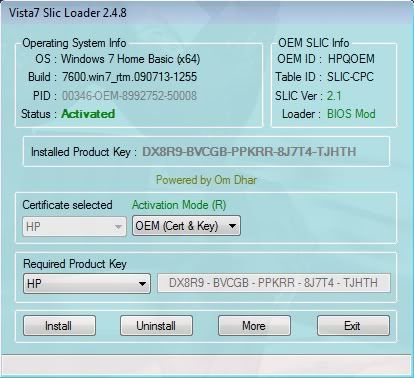
Windows Vista (codenamed Longhorn) is an operating system by Microsoft for use on personal computers, including home and business desktops, laptops, tablet PCs and. Project Description A very small tool for find out what your Windows Product key is. Good for when you need to reinstall windows but can't find your CD case.
How to Find Your Windows 9. ME Product Key Code. Considering how old Windows 9. Windows 9. 5, and Windows ME are, it's no surprise that you've lost the product key you used to install the operating system.
Unlike with product keys in newer version of Windows, these older ones stored their valid product keys nice and neat, in a specific registry key, making finding yours pretty easy. All you have to do to find that lost product key is navigate to that spot in the Windows Registry and then jot it down. Once you have it, you can reinstall Windows successfully using that code. Note: Please read my Windows Product Keys FAQ for more information about product keys in Windows, how many times you can use them, and more. Important: While no changes are made to the registry in any of these steps, it's always a good idea to back up the registry keys you'll be working with, or even the entire registry, just to be safe.
Windows 7 Starter Product Key Free for You 2K8WH-JVQDM-C9HVC-YR2XC-8M76G 2TXWY-BCHXT-2443M-YDQX2-7PRBJ 2V3W2-JXTTR-28RD8-R228D-KR69C 2VFV4-WKYV7-KD8PF. Other Windows 10 Product Key. Windows 10 Professional Insider Preview build 10074, 10122, and 10130: 6P99N-YF42M-TPGBG-9VMJP-YKHCF; Windows 10 Technical Preview. Need your Microsoft product id but can’t find your original documentation? We often need to know the product id but most of us never keep up with the original.
Follow the easy steps below to locate your Windows 9. ME product key code from the Windows Registry, a process that shouldn't take more than 1.

How to Find Your Windows 9. ME Product Key. Open Registry Editor, a tool included in all versions of Windows that you can use to view and edit areas in the Windows Registry. Note: As I mentioned above, you will not be making changes in Registry Editor, you'll just be viewing information. Please follow the steps below exactly as shown to avoid causing a problem in this very sensitive area in Windows. Tip: If working in the Windows Registry makes you nervous, you have the option of using a a special program to show you this key.

See my List of Free Product Key Finder Programs for more. I recommend the process below, however. Locate the HKEY. We just need to dig a bit deeper to get to it. Click on the . From that much longer list, find Windows. Once you find Windows, click the . The other ones do not contain a copy of your product key.
Click on the Current. Version key - the word itself, not the. Values are listed alphabetically so if you don't see it right away, scroll down until you get to the P's. They numbers and letters within this value represent the Windows 9. ME product key. The product key should be formatted like xxxxx- xxxxx- xxxxx- xxxxx- xxxxx - five sets of five letters and numbers. Write down your product key exactly as you see it here.
You'll have to enter this product key just as shown when you reinstall Windows. If you're off by even one character, it won't work. Close Registry Editor without making any changes. Tips & More Information. If your computer system was purchased with Microsoft Windows pre- installed, and it's never been reinstalled upgraded since then, the product key found by the steps on this page will only find the generic product key that your computer manufacturer used to install the Windows. This product key will not work when attempting to reinstall Windows. In this case, you must use the unique product key that is on the sticker attached to your computer case.
Windows Vista - Wikipedia. Windows Vista (codenamed Longhorn. Development was completed on 8 November 2. On 3. 0 January 2. It was succeeded by Windows 7, which was released to manufacturing on 2.
July 2. 00. 9 and released worldwide for retail on 2. October 2. 00. 9. New features of Windows Vista include an updated graphical user interface and visual style dubbed Aero, a new search component called Windows Search, redesigned networking, audio, print and display sub- systems, and new multimedia tools such as Windows DVD Maker. Vista aimed to increase the level of communication between machines on a home network, using peer- to- peer technology to simplify sharing files and media between computers and devices. Windows Vista included version 3. NET Framework, allowing software developers to write applications without traditional Windows APIs.
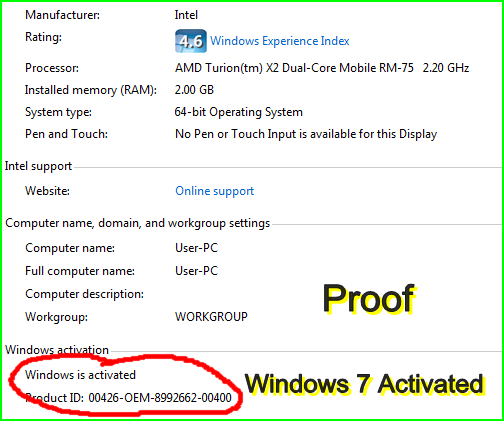
Windows 7 Professional Product Key Free Download. Windows 7 Professional Product Key 2016 is easily the most simplest tool to activate Windows 7 Professional 32bit. How to find Windows 8, 7, Vista & XP product key. If you 're preparing to reinstall Windows, then you need the Windows product key for installation and activation. Windows 7 and Windows Vista or their server variants have a new graphical user interface (GUI) that allows user to easily change or re-enter the product key (aka. Windows 7 Professional Product Key Free for You. Development of Windows Vista occurred over the span of five and a half years, starting in earnest in May 2001, prior to the release of Microsoft's Windows XP.
Microsoft's primary stated objective with Windows Vista was to improve the state of security in the Windows operating system. In light of this, Microsoft chairman Bill Gates announced in early 2. Criticism of Windows Vista has targeted its high system requirements, its more restrictive licensing terms, the inclusion of a number of, then, new DRM technologies aimed at restricting the copying of protected digital media, lack of compatibility with some pre- Vista hardware and software, longer boot time, and the number of authorization prompts for User Account Control. As a result of these and other issues, Windows Vista had seen initial adoption and satisfaction rates lower than Windows XP.
It was originally expected to ship sometime late in 2. Windows XP and Blackcomb, which was planned to be the company's next major operating system release. Gradually, . In some builds of Longhorn, their license agreement said . Many of Microsoft's developers were also re- tasked to build updates to Windows XP and Windows Server 2. Faced with ongoing delays and concerns about feature creep, Microsoft announced on 2.
August 2. 00. 4, that it had revised its plans. For this reason, Longhorn was reset to start work on componentizing the Windows Server 2. Service Pack 1 codebase, and over time re- incorporating the features that would be intended for an actual operating system release. However, some previously announced features such as Win. FS were dropped or postponed, and a new software development methodology called the Security Development Lifecycle was incorporated in an effort to address concerns with the security of the Windows codebase, which is programmed in C, C++ and assembly. Longhorn became known as Vista in 2.
During this period, Microsoft was fairly quiet about what was being worked on, as their marketing and public relations focus was more strongly focused on Windows XP, and Windows Server 2. April 2. 00. 3. Occasional builds of Longhorn were leaked onto popular file sharing networks such as IRC, Bit. Torrent, e. Donkey and various newsgroups, and so most of what is known about builds prior to the first sanctioned development release of Longhorn in May 2.
After several months of relatively little news or activity from Microsoft with Longhorn, Microsoft released Build 4. Internet around 2. February 2. 00. 3.
As an evolutionary release over build 3. An optional . The incorporation of the Plex theme made blue the dominant color of the entire application. The Windows XP- style task pane was almost completely replaced with a large horizontal pane that appeared under the toolbars.
A new search interface allowed for filtering of results, searching of Windows help, and natural- language queries that would be used to integrate with Win. FS. The animated search characters were also removed. File metadata was also made more visible and more easily editable, with more active encouragement to fill out missing pieces of information. Also of note was the conversion of Windows Explorer to being a . NET application. Most builds of Longhorn and Vista were identified by a label that was always displayed in the bottom- right corner of the desktop.
A typical build label would look like . Higher build numbers did not automatically mean that the latest features from every development team at Microsoft was included. Typically, a team working on a certain feature or subsystem would generate their own working builds which developers would test with, and when the code was deemed stable, all the changes would be incorporated back into the main development tree at once. At Microsoft, a number of .
The name of the lab in which any given build originated is shown as part of the build label, and the date and time of the build follows that. Some builds (such as Beta 1 and Beta 2) only display the build label in the version information dialog (Winver). The icons used in these builds are from Windows XP. At the Windows Hardware Engineering Conference (Win. HEC) in May 2. 00. Microsoft gave their first public demonstrations of the new Desktop Window Manager and Aero.
The demonstrations were done on a revised build 4. A number of sessions for developers and hardware engineers at the conference focused on these new features, as well as the Next- Generation Secure Computing Base (previously known as .
Also at this conference, Microsoft reiterated their roadmap for delivering Longhorn, pointing to an . Internally, some Microsoft employees were describing the Longhorn project as . It offered only a limited subset of features planned for Longhorn, in particular fast file searching and integrated graphics and sound processing, but appeared to have impressive reliability and performance compared to contemporary Longhorn builds. Allchin went on to explain how in December 2.
Brian Valentine and Amitabh Srivastava, the former being experienced with shipping software at Microsoft, most notably Windows Server 2. Future Longhorn builds would start from Windows Server 2.
Service Pack 1 and continue from there. This change, announced internally to Microsoft employees on 2.
August 2. 00. 4, began in earnest in September, though it would take several more months before the new development process and build methodology would be used by all of the development teams. A number of complaints came from individual developers, and Bill Gates himself, that the new development process was going to be prohibitively difficult to work within. As Windows Vista. By approximately November 2. In the end, Microsoft chose Windows Vista as confirmed on 2.
July 2. 00. 5, believing it to be a . That's what Windows Vista is all about: . In September of that year, Microsoft started releasing regular Community Technology Previews (CTP) to beta testers from July 2. February 2. 00. 6. The first of these was distributed at the 2.
Microsoft Professional Developers Conference, and was subsequently released to beta testers and Microsoft Developer Network subscribers. The builds that followed incorporated most of the planned features for the final product, as well as a number of changes to the user interface, based largely on feedback from beta testers. Windows Vista was deemed feature- complete with the release of the . Beta 2, released in late May, was the first build to be made available to the general public through Microsoft's Customer Preview Program. It was downloaded by over five million people. Two release candidates followed in September and October, both of which were made available to a large number of users. The UEFI 2. 0 specification (which replaces EFI 1.
Microsoft's announcement, no firmware manufacturers had completed a production implementation which could be used for testing. As a result, the decision was made to postpone the introduction of UEFI support to Windows; support for UEFI on 6.
Vista Service Pack 1 and Windows Server 2. UEFI would not be supported, as Microsoft does not expect many such systems to be built as the market moves to 6. Because a release to manufacturing (RTM) build is the final version of code shipped to retailers and other distributors, the purpose of a pre- RTM build is to eliminate any last .
Thus, it is unlikely that any major new features would be introduced; instead, work would focus on Vista's . In just a few days, developers had managed to drop Vista's bug count from over 2. September to just over 1. RC2 shipped in early October. However, they still had a way to go before Vista was ready to RTM. Microsoft's internal processes required Vista's bug count to drop to 5.
RTM. During a demonstration of the speech recognition feature new to Windows Vista at Microsoft's Financial Analyst Meeting on 2. July 2. 00. 6, the software recognized the phrase . After several failed attempts to correct the error, the sentence eventually became . On 1. 6 November 2. Microsoft made the final build available to MSDN and Technet Plus subscribers.
Laptop users report, however, that enabling Aero shortens battery life. A search box appears in every Explorer window. The address bar has been replaced with a breadcrumb navigation bar. Icons of certain file types in Windows Explorer are .
The preview pane allows users to see thumbnails of various files and view the contents of documents. The details pane shows information such as file size and type, and allows viewing and editing of embedded tags in supported file formats. The Start menu has changed as well; incorporating an instant search box, and the All Programs list uses a horizontal scroll bar instead of the cascading flyout menu seen in Windows XP.
Gadgets can also be placed on the desktop. IE7 in Windows Vista runs in isolation from other applications in the operating system (protected mode); exploits and malicious software are restricted from writing to any location beyond Temporary Internet Files without explicit user consent. Windows Media Player 1.
Microsoft's program for playing and organizing music and video. New features in this version include word wheeling (incremental search or .


/http%3A%2F%2Fwww.lamaisoninfo.com%2Fcatalog%2Fimages%2Fproducts%2Fantennes-wifi%2Freseautique%2Ftplink_wn8200nd.jpg)
/http%3A%2F%2Fwww.llmstudy.com%2Ffiles%2Fprofile%2Fgroningen_university_law%2Fgrogingen_law_students_pic.jpg)
/http%3A%2F%2Fi191.photobucket.com%2Falbums%2Fz193%2Fudaramaya%2Fver146.jpg)
/http%3A%2F%2Fkb.epson-europe.com%2Fpf%2F12%2Fwebfiles%2FArticle%20Images%2FOperating%20Systems%2FWin%2095%20-%2098%20-%20ME%2FPrinter%20Driver%2FWin9x-Main_Adv-Black_ink_only.png)